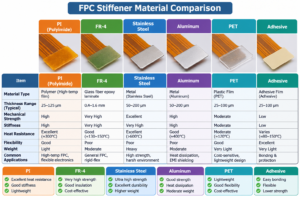
Common materials for FPC (Flexible Printed Circuit) stiffeners are: PI (polyimide), FR4 (fiberglass-reinforced epoxy resin), and stainless steel.
There are other options but not as common as 3 types upon: aluminum, PET, and another important part that we cannot neglect: 3M adhesive, which is used as a bonding layer.
Thicknesses depending on the materials and the applications, below is a detailed list, concluding based on standard industry specifications and experience.
Stiffener Materials and Typical Thicknesses
1. PI (Polyimide)
– Characteristics and Applications:
Offers high-temperature resistance and excellent compatibility with FPC base materials, while maintaining flexibility.
Commonly used for gold-finger insertion backup areas and the back of ZIF (Zero Insertion Force) connector interfaces.
– Typical Thicknesses: 0.1mm, 0.15mm, 0.2mm, 0.225mm, 0.25mm, etc.
2. FR4 (Fiberglass-Reinforced Epoxy Resin)
– Characteristics and Applications:
Provides high mechanical strength and rigidity. Suitable for areas where components are mounted, around through-hole components, or as a support structure where strict flatness requirements.
– Typical Thicknesses: 0.1mm, 0.2mm, 0.4mm, 0.6mm, 0.8mm, 1.0mm, 1.2mm, 1.6mm, etc.
3. Stainless Steel (Steel Stiffeners)
– Characteristics and Applications:
Offers exceptional flatness and high strength, with some heat-dissipation properties. Used behind heavy components — such as BGAs or QFNs — or in areas requiring high rigidity.
Note: Must not be used near Hall-effect sensors or components sensitive to magnetic fields.
– Typical Thicknesses: 0.1mm, 0.2mm, and 0.3mm are most common; some manufacturers can provide thicknesses up to 0.4mm or 0.5mm.
4. Aluminum
– Characteristics and Applications:
Lightweight with good thermal conductivity;
Widely used in applications that require both heat dissipation and increased structural rigidity.
– Common thicknesses:
A wide range is available, typically including 0.1mm, 0.2mm, 0.3mm, etc., with some options reaching up to 2.0mm.
5. PET (Polyester)
– Characteristics and applications:
Lower cost, offers less strength support and heat resistance than PI and FR4.
Commonly used for general reinforcement where high performance is not required, or in cost-sensitive applications.
– Common thicknesses: 0.225mm, etc.
Additional:
3M Adhesive/Backing Adhesive (as a bonding layer)
– Characteristics and applications:
Used to bond stiffeners to an FPC, or to secure an FPC directly to a housing or bracket. It is important to verify whether the adhesive is heat-resistant.
– Common thicknesses: Typical part numbers are 3M 9077 (0.05mm, heat-resistant), 3M 468 (0.13mm, not heat-resistant), and tesa 8854 (0.1mm, heat-resistant).
Engineering note:
When selecting the material and thickness for stiffener, the key factor to consider is individual thickness, also the total thickness (FPC substrate + adhesive layer + stiffener) to ensure it meets the tolerance requirements of connectors or structural components, for example, the total thickness in the “gold finger” (contact pad) area must comply with connector specifications, and the compliance and compatibility, so the thickness of stiffener must be considered.
The thickness ranges and performance ratings are indicative only, actual values depend on material grade, supplier specifications, and FPC construction. Adhesive is generally a bonding layer but not structural stiffener.