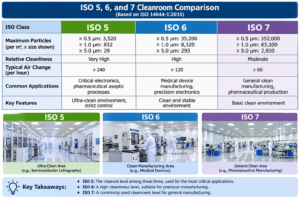
Cleanliness classes for electronics manufacturing facilities are typically defined by based on ISO 14644-1:2015, where a lower number indicates a higher level of cleanliness.
ISO classes 5, 6, and 7 correspond to various stages in electronics manufacturing, ranging from core precision processes to general packaging, testing, and assembly.
Comparison of Key Parameters for ISO Classes 5, 6, and 7
The primary metric for measuring cleanliness is the concentration of airborne particles.
Based on the ISO 14644-1 standard, the following table compares the limits for particles ≥0.5μm — a size of particular concern in the electronics industry:
Cleanroom Classification Comparison (ISO 5, ISO 6 & ISO 7)
Cleanliness Class | Max. Concentration of Particles ≥0.5 μm (particles/m³) | Legacy Standard Reference (Fed Std 209E) | Airflow Pattern and Characteristics |
|---|---|---|---|
ISO 5 | ≤ 3,520 | Class 100 | Typically utilizes unidirectional (laminar) airflow. Uniform air velocity ensures rapid removal of airborne contaminants. |
ISO 6 | ≤ 35,200 | Class 1,000 | Typically utilizes non-unidirectional (turbulent) airflow. Relies on dilution to control contamination. |
ISO 7 | ≤ 352,000 | Class 10,000 | Utilizes non-unidirectional airflow with a lower air-change rate than ISO 6. Commonly used for general electronics assembly. |
Typical Applications in Electronics Manufacturing
Different products have varying sensitivities to particulate matter, leading to distinct cleanliness requirements:
1. ISO Class 5: High-Precision and Core Processes
This class is primarily used to prevent particles from causing short circuits in chips or obstructing optical paths.
Semiconductor/Chip Packaging and Testing: High-precision packaging (e.g., flip-chip, wafer-level packaging) and photolithography process areas.
Precision Optics: Critical operations such as lens coating for camera modules and chip-level packaging. Special High-Requirement Environments: Certain core processes in aerospace electronics or high-reliability military-grade products may require a Class 100 (ISO 5) environment.
2. ISO Class 6: Standard Packaging and Sensitive Assembly
Suitable for processes that have a certain tolerance for particulates, yet where even minor contamination could still negatively impact yield.
Semiconductor Packaging and Testing: Standard wire bonding and testing areas typically fall under this classification.
High-Requirement SMT: Assembly processes for medical device electronics and automotive electronics (such as ADAS sensors or radar modules) often require a Class 1,000 (ISO 6) environment to minimize soldering defects.
Precision Components: Assembly stages for components such as those used in camera modules.
3. ISO Class 7: General Electronic Assembly and Consumer Electronics
This is the most common cleanroom classification in electronics manufacturing, serving to prevent dust from causing physical obstructions or circuit corrosion.
Consumer Electronics: SMT placement and assembly for smartphones, tablets, and wearable devices. For instance, an ISO Class 7 environment is typically recommended for the SMT assembly areas of mobile phone motherboards.
Standard SMT: For industrial control products and general consumer electronics, a Class 10,000 (ISO 7) environment is usually sufficient enough.
Back-end Processes: Operations such as molding, dicing, and packaging within semiconductor manufacturing.
Selection Guidance
When planning a new facility or production line, there is no need to pursue the highest possible classification. Higher classifications lead to a huge increase in both initial investment and operational energy consumption (due to factors like the high density of fan filter and significantly higher electricity costs).
It is generally advisable to implement high-classification “micro-environments” only at critical processes — such as photolithography or high-precision component placement — while utilizing lower-classification environments for common areas.